

Start here
A treatment plan starts with the cancer type and stage.
- Tests establish the diagnosis, extent of disease, and your fitness for treatment.
- Surgery may be one part of a plan that includes other cancer treatments.
- Dr. Servais uses robotic minimally invasive surgery in nearly all lung cancer operations, including complex cases.
Understanding lung cancer
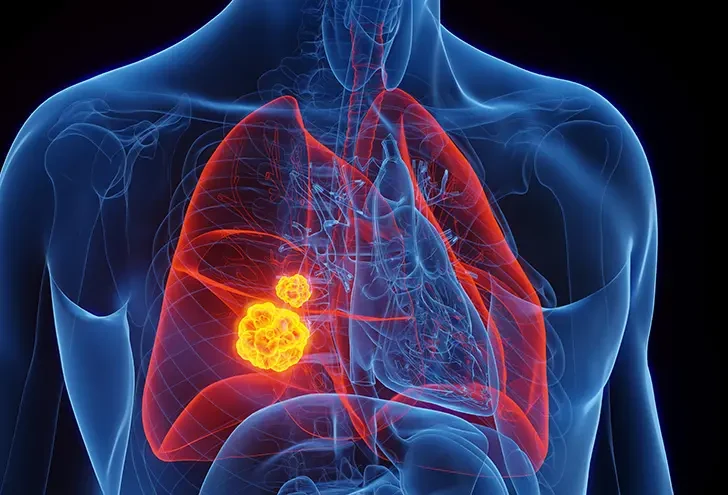
Lung cancer begins when cells in the lung grow abnormally and form a tumor. It can occur in people who currently smoke, people who have quit, and people who have never smoked. A diagnosis calls for a careful assessment of the cancer and your overall health.[1]
Non-small cell lung cancer
The most common group of lung cancers, often abbreviated NSCLC. It includes adenocarcinoma and squamous cell carcinoma. Surgery is an important treatment for many cancers found at an early stage.
Small cell lung cancer
A different type that often grows and spreads more quickly. Treatment usually relies on medicines and sometimes radiation. Surgery has a role in only a small, carefully selected group of patients.
This guide focuses mainly on non-small cell lung cancer and decisions about surgery.
How is it found?
Some lung cancers are found on a screening CT scan or a scan obtained for another reason, before symptoms develop. Others cause a persistent or changing cough, shortness of breath, coughing up blood, chest or shoulder pain, hoarseness, or unexplained weight loss. These symptoms can also have other causes and should be discussed with your clinician.
Confirming the diagnosis and learning the stage
The evaluation answers two questions: What is the tumor? and Where is it? Not everyone needs every test. Your team selects tests that can clarify the diagnosis or change the treatment plan.
- Chest CT
- Shows the lung finding in detail, including its size and relationship to nearby structures. Comparing it with older scans can be useful.
- PET/CT
- Looks for areas of increased activity in the tumor, lymph nodes, or elsewhere. Inflammation can also appear active, so a PET result sometimes needs confirmation with a biopsy.
- Biopsy
- Provides tissue for examination under a microscope. A sample may be obtained through the airways during bronchoscopy, with an image-guided needle through the chest, or during surgery.
- Robotic bronchoscopy and EBUS
Allows the lung nodule and nearby chest lymph nodes to be biopsied during the same procedure. While you are asleep under general anesthesia, a physician controls an advanced catheter guided by robotic technology to reach the nodule through the airways. EBUS (endobronchial ultrasound) guides sampling of nearby lymph nodes.[6][8][9]
The procedure is generally safe and can provide highly accurate results, with most patients returning home the same day. Occasionally, an inconclusive biopsy requires additional testing.[6][8]
- Lymph node sampling
- Checks whether cancer has reached lymph nodes. Endobronchial ultrasound (EBUS) allows a clinician to sample some nodes through the airways. Occasionally a separate surgical procedure is needed.
- Brain MRI
- May be recommended based on the suspected stage, symptoms, and other findings to check for spread to the brain.
Why might the tumor need additional testing?
Biomarker testing looks for changes in cancer cells that may help guide treatment. These can include gene changes, such as EGFR or ALK, and proteins such as PD-L1. Results can influence whether targeted therapy or immunotherapy is appropriate. Tumor testing is different from testing for an inherited cancer risk.[2]
How is a treatment plan chosen?
The cancer’s type, stage, and biomarkers matter, along with lung function, other medical conditions, and your preferences. At Lahey Clinic, thoracic surgeons work with pulmonary specialists, medical oncologists, radiation oncologists, radiologists, and pathologists to determine and coordinate the best care plan.[4] Cases are discussed by this team of doctors at the weekly Multidisciplinary Thoracic Oncology Conference (MTOC), also known as a “Tumor Board.”
Stage describes the extent of cancer. The overview below explains common patterns; the exact stage and treatment plan require an individual assessment.
Stage I
Cancer is confined to the lung without lymph node involvement. Surgery is often the main treatment when a person can safely undergo an operation. Focused radiation may be an alternative when surgery is unsuitable or declined.
Stage II
The tumor is more extensive or involves certain nearby lymph nodes. Surgery often remains part of treatment, with medicines before or after the operation in appropriate patients.
Stage III
Cancer involves more extensive lymph nodes or nearby structures. Treatment usually combines approaches. Selected patients may have surgery after initial treatment; others are best treated with chemotherapy and radiation, with additional medicines when appropriate.
Stage IV
Cancer has spread to distant sites, the opposite lung, or the lining around the lung or heart in certain patterns. Medicines are usually central to treatment. Radiation or surgery may have a role in carefully selected situations.
When treatment starts before surgery
For some cancers that can be removed, the team recommends chemotherapy, often with immunotherapy, before an operation. This is called neoadjuvant therapy. Treatment given after surgery is called adjuvant therapy. The aim is to treat cancer cells beyond the visible tumor and reduce the risk of recurrence. A plan that starts with medicines may still include surgery.
Other treatments you may hear about
- Chemotherapy
- Medicines that kill cancer cells or interfere with their growth.
- Immunotherapy
- Medicines that help the immune system recognize and attack cancer. Suitability depends on the cancer’s features and your health.
- Targeted therapy
- Medicines directed at a particular change in the cancer cells. They are used when the tumor has a matching biomarker.
- Radiation therapy
- Treatment directed at a defined area. Stereotactic body radiation therapy (SBRT) delivers focused treatment over a small number of sessions and is an important option for certain early cancers when surgery is not appropriate.
These treatments can cause side effects. The team will discuss the expected benefit, the relevant risks, and the alternatives for your situation. Clinical trials may also offer an appropriate treatment option.
What does lung cancer surgery remove?
The goal is to remove the cancer completely while preserving as much healthy lung as is appropriate. The operation depends on the tumor’s size and location, lymph node findings, and how well your lungs work. Lymph nodes are also sampled or removed to help determine the stage.
For some centrally located tumors, a sleeve resection removes an involved section of airway and reconnects the remaining airway, potentially preserving more lung. More complex tumors may require additional reconstruction or removal of nearby tissue. These decisions need individualized surgical planning.[1]
Robotic thoracic surgery
Dr. Servais’s approach to lung surgery
During robotic surgery, Dr. Servais controls the instruments from a console in the operating room. A magnified, three-dimensional view and articulated instruments allow him to work through small incisions between the ribs. The robot does not make decisions or operate independently.[3]
Minimally invasive surgery may reduce pain and shorten recovery compared with an open chest incision. The priorities remain complete cancer removal, appropriate lymph node evaluation, and safety. An open operation, or a change to an open approach during surgery, may be necessary depending on the findings.[3,4]
The proposed operation is tailored to the cancer, your anatomy, lung function, and any previous treatment. Robotic surgery is one part of the overall cancer treatment plan.
Learn about lung cancer care at Lahey ClinicPreparing for surgery and recovery
Before an operation
Breathing tests help estimate how well you could tolerate the planned lung resection. You may also need an assessment of your heart health or exercise capacity. Your team will review medications, nutrition, activity, and any support you may need at home.[5]
If you smoke, stopping remains worthwhile after a diagnosis. Your care team can offer medications and support to help you quit.
After an operation
A chest tube usually drains air and fluid while the lung heals. Pain treatment, breathing exercises, and walking are important parts of recovery. The hospital stay and return to usual activities depend on the operation, your baseline health, and how you recover.[3,5]
Risks include an ongoing air leak, pneumonia or other infection, bleeding, blood clots, an irregular heartbeat, and breathing difficulties. Your surgeon will discuss the risks most relevant to you. Before discharge, ask for clear instructions about medicines, activity, wound care, and when to call the team.[3,5]
Follow-up is part of treatment
The final pathology report helps determine whether additional treatment is recommended. Follow-up visits and scans monitor recovery and look for recurrence or another lung cancer. Report new or worsening symptoms between scheduled visits. Emotional support, symptom management, and rehabilitation can be included throughout care.
A note about lung cancer screening
Read the full lung cancer screening guide →
Screening uses a low-dose CT scan to look for lung cancer in people at increased risk who do not have symptoms. Under USPSTF guidance, annual screening is recommended for adults aged 50–80 with at least a 20 pack-year smoking history who currently smoke or quit within the past 15 years. A pack-year means smoking one pack a day for one year.[7]
Eligibility also depends on overall health and willingness to undergo treatment. Guidelines and insurance criteria can differ, so discuss eligibility, benefits, and possible harms with your clinician. New symptoms need medical evaluation rather than waiting for a screening appointment.
Questions to bring to your consultation
- What type and stage of lung cancer do I have? Is any testing still needed?
- Has biomarker testing been done, and could it change my treatment?
- Should treatment begin with surgery, medicines, radiation, or a combination?
- If I have surgery, how much lung would be removed? Could it be done robotically?
- How do my breathing tests and other health conditions affect the options and risks?
- What should I expect during recovery, and what help will I need at home?
- Could a clinical trial be appropriate, and what follow-up will I need?
Bring your questions and an up-to-date medication list. Ask the office how to send outside scans, biopsy results, and other records before your visit.
Sources & further reading
About this guide
Patient education based on teaching materials by Elliot Servais, MD, FACS, and the references below. This information supports a discussion with your care team and does not determine an individual treatment plan.
Patient resources, references & image credits
Patient resources
- National Cancer Institute. Non-Small Cell Lung Cancer Treatment (PDQ®), Patient Version.
- National Cancer Institute. Biomarker Testing for Cancer Treatment.
- American Lung Association. Robotic Thoracic Surgery.
- Lahey Clinic. Lung Cancer Care.
- American College of Surgeons. Your Lung Operation.
- American Lung Association. Robotic-Assisted Bronchoscopy.
Research, clinical guidance & lectures
- US Preventive Services Task Force. Lung Cancer: Screening.
- Memorial Sloan Kettering Cancer Center. Shape-Sensing Robotic-Assisted Bronchoscopy May Improve Diagnostic Efficiency, Shorten Time to Treatment for Patients with Malignant Lung Lesions.
- McLoughlin KC, Bott MJ. Robotic Bronchoscopy for the Diagnosis of Pulmonary Lesions. Thoracic Surgery Clinics. 2023;33:109–116.
Image credits
- Lung resection illustration: © Mayo Foundation for Medical Education and Research. Reproduced in Surgical Management of Lung Cancer, slide 41.
Updated October 4, 2026. This guide is general information; your care team can explain which recommendations apply to you.