
Start here
Esophageal cancer care involves a team of specialists.
- The stage of the cancer and your overall health guide the treatment options.
- Very early cancers may be treated with surgery or endoscopic therapy alone. Most esophageal cancers require a combination of treatments, including surgery, chemotherapy, and possibly immunotherapy or radiation.
- Robotic esophagectomy is a minimally invasive operation to remove esophageal cancer. Care planning includes nutrition, recovery, and long-term follow-up.
Understanding esophageal cancer
The esophagus is the muscular tube that carries food from the throat to the stomach. Esophageal cancer develops when abnormal cells in its lining grow into a tumor. A cancer at the point where the esophagus meets the stomach is called a gastroesophageal junction, or GEJ, cancer. Its precise location helps determine treatment.
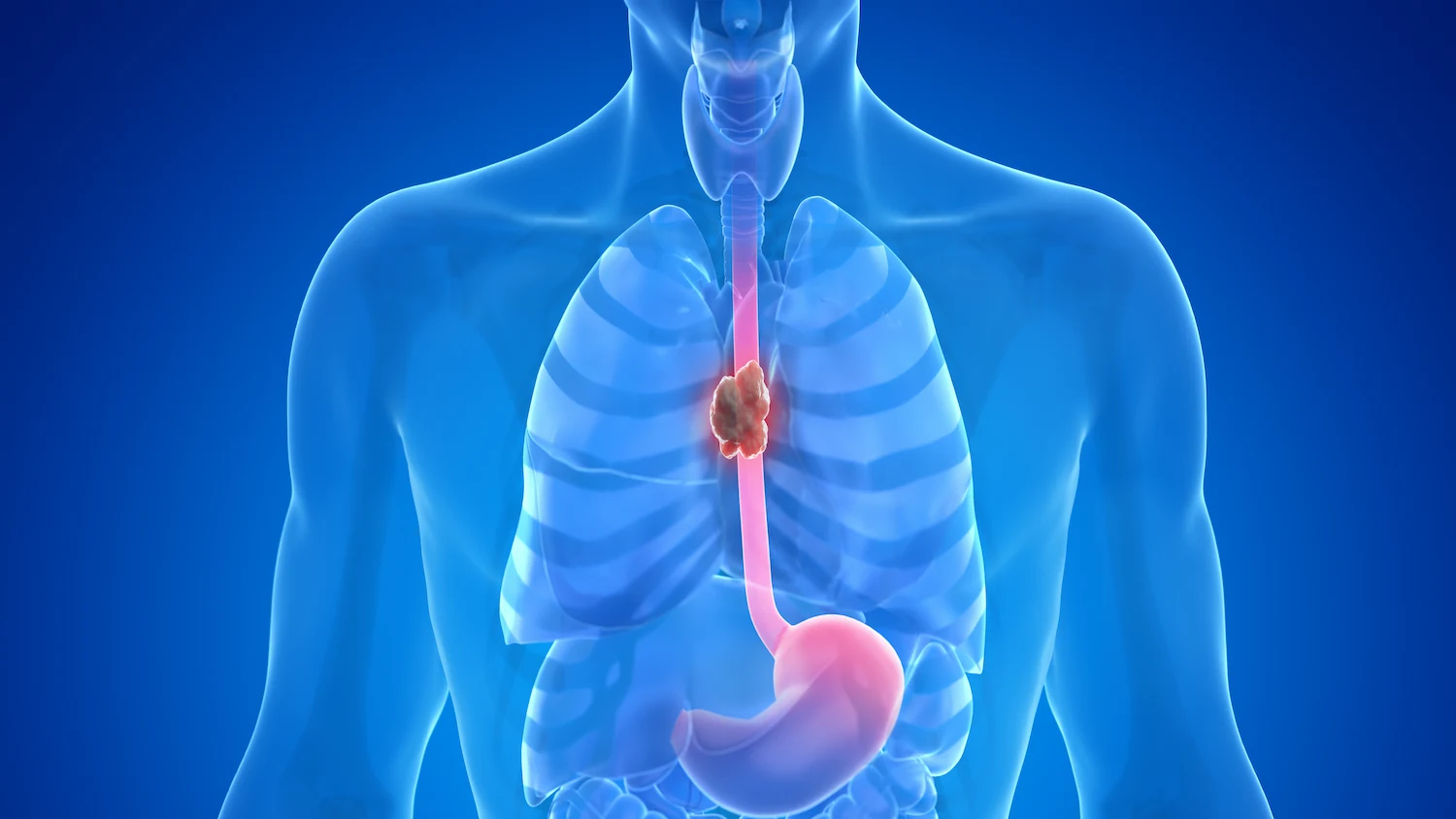
Adenocarcinoma
Usually develops in the lower esophagus or at the junction with the stomach. It can be associated with longstanding reflux and Barrett’s esophagus, a change in the esophageal lining. Most people with Barrett’s esophagus do not develop cancer.
Squamous cell carcinoma
Develops from the flat cells lining the esophagus and more often occurs in its upper or middle portion. The treatment plan can differ from the plan for adenocarcinoma.
The biopsy identifies the cancer type. This guide discusses both types, with particular attention to the role of surgery.[2]
What symptoms should be evaluated?
Difficulty swallowing, particularly food that increasingly feels stuck, is a common symptom. Unintentional weight loss, pain with swallowing, chest discomfort, or a persistent hoarse voice may also occur. Some early cancers cause no symptoms and are found during endoscopy. These symptoms have many possible causes, but worsening swallowing deserves prompt evaluation.
Confirming the diagnosis and learning the stage
A biopsy confirms the diagnosis. Additional tests help determine how deeply the cancer has grown, whether lymph nodes are involved, and whether it has spread elsewhere. Your team chooses tests according to the tumor and the decisions being considered.
- Upper endoscopy & biopsy
- A flexible camera passes through the mouth to examine the esophagus and stomach. Small tissue samples are examined by a pathologist to identify the cancer type.
- CT scan
- Evaluates the tumor, nearby structures, lymph nodes, and other parts of the body for signs of spread.
- PET/CT
- Looks for areas of increased activity that could represent cancer. Inflammation can also appear active, so some findings require further evaluation or biopsy.
- Endoscopic ultrasound
- Uses an ultrasound probe on an endoscope to assess the layers of the esophageal wall and nearby lymph nodes. Selected nodes can be sampled when the result could change treatment.
- Other selected tests
- Bronchoscopy may assess a tumor close to the airway. In some junctional cancers, laparoscopy may be used to look for spread within the abdomen.
Biomarker testing examines features of the tumor that may guide medicines. Depending on the cancer type and stage, tests may include HER2, PD-L1, and mismatch repair or microsatellite instability testing. Ask which results are relevant to your plan.[5]
How is a treatment plan chosen?
Treatment depends on the cancer’s type, location, depth, lymph nodes, and any spread beyond the esophagus, together with your health and preferences. At Lahey Clinic, thoracic surgeons, gastroenterologists, medical and radiation oncologists, radiologists, and pathologists work together to plan care.[2]
Many patients need more than one type of treatment. These are common patterns rather than a treatment recommendation for an individual person:
Very early cancer
Selected cancers confined to the inner lining can be removed through an endoscope. The removed tissue is examined to determine whether endoscopic treatment is sufficient. Deeper growth or higher-risk features may make surgery necessary.
At Lahey Clinic, endoscopic treatment for very early esophageal cancer is often performed in collaboration with the Advanced Endoscopy Gastroenterology team. Endoscopic submucosal dissection (ESD) is one technique used to remove selected early tumors.[6]
Localized cancer
Some cancers can be treated with surgery first. Others benefit from treatment before surgery even when no lymph node involvement is apparent. The depth of the tumor and other risk factors help guide that choice.
Locally advanced cancer
For a cancer that extends deeper into the wall or involves nearby lymph nodes, treatment commonly begins with chemotherapy, with or without radiation, followed by surgery when appropriate.
Treatment without surgery
Chemotherapy and radiation together can be the main treatment, particularly for some squamous cell cancers or when an operation is unsuitable. Certain very early cancers can also be managed endoscopically.
Cancer that has spread
Medicines are generally the main treatment for distant spread. Radiation, endoscopic procedures, and other supportive measures can help swallowing, pain, and nutrition. Esophagectomy is usually not part of this treatment plan.
Medicines and radiation around the time of surgery
Neoadjuvant means treatment before surgery; adjuvant means treatment afterward. Perioperative treatment spans both. These approaches aim to treat the visible tumor and cancer cells that may be present elsewhere but cannot yet be seen.
More detail: chemotherapy and immunotherapy options
For many suitable patients with resectable, locally advanced adenocarcinoma, chemotherapy before and after surgery using a combination called FLOT is an important option. Chemotherapy with radiation before surgery remains appropriate in selected situations, and is commonly used for squamous cell cancer when surgery is planned.[7,8]
Immunotherapy may also be part of treatment. Nivolumab may be recommended when cancer remains in the surgical specimen after chemotherapy and radiation, despite complete removal of the tumor. For certain resectable GEJ adenocarcinomas, durvalumab with FLOT before and after surgery, followed by durvalumab alone, is another option. These treatments have specific eligibility criteria and potential side effects.[7,9]
Your team will explain why a particular sequence is recommended and whether a clinical trial is worth considering.
What does an esophagectomy involve?
An esophagectomy removes the affected portion of the esophagus, surrounding tissue, and nearby lymph nodes. The aim is complete cancer removal with clear margins, meaning no cancer at the cut edges. Lymph node examination helps assess the cancer’s extent and response to treatment.
Rebuilding the swallowing passage
Usually, the stomach is reshaped into a narrower tube and brought upward to connect to the remaining esophagus. This tube is called a gastric conduit. The new connection is called an anastomosis.
If the stomach cannot be used, another part of the digestive tract may be needed for reconstruction. The plan depends on the tumor and any previous operations.
Eating remains possible after recovery, but the new anatomy changes meal size, swallowing, and digestion. Nutrition guidance is an essential part of care.
Names you may hear
- Ivor Lewis esophagectomy
- Involves the abdomen and chest, with the new connection made in the chest. It is commonly used for cancers of the lower esophagus and junction.
- McKeown esophagectomy
- Involves the abdomen, chest, and neck, with the new connection made in the neck. It may be useful when more of the upper esophagus needs removal.
- Other approaches
- A transhiatal operation or a different reconstruction may be appropriate in selected cases. The tumor’s location and the ability to remove it completely guide the choice.
Robotic esophageal surgery
Dr. Servais’s surgical approach
Robotic-assisted minimally invasive esophagectomy is sometimes called RAMIE. Dr. Servais controls the instruments from a console in the operating room, using a magnified, three-dimensional view and instruments that can move within the confined spaces of the chest and abdomen. The surgeon directs every movement.
Minimally invasive approaches can reduce some short-term complications and support recovery compared with open surgery. Esophagectomy remains a major operation, and small incisions do not eliminate its risks. An open approach may be needed when the anatomy, tumor, or findings during surgery make it the safer choice.
The priorities are complete cancer removal, appropriate lymph node evaluation, a well-perfused reconstruction, and recovery that supports the overall treatment plan. “Well-perfused” means the tissue used for the new swallowing passage has an adequate blood supply.
Learn about thoracic cancer care at Lahey ClinicPreparing for surgery and recovery
Building strength before an operation
Your team will assess heart and lung health, activity level, nutrition, medications, and support at home. Maintaining activity as you are able, addressing weight loss, and stopping smoking can help prepare you for treatment. A dietitian can recommend food adjustments, supplements, or feeding support when swallowing limits intake.
A feeding tube into the small intestine, called a jejunostomy or J-tube, may be used before or after surgery. The need for a tube and the feeding schedule depend on the individual plan. It does not necessarily mean you will be unable to eat normally in the longer term.
In the hospital
Recovery includes pain treatment, breathing exercises, walking, and close attention to nutrition and the new connection. You may have drains, a chest tube, or a tube through the nose to decompress the stomach. The team decides when it is safe to begin drinking and eating. Hospital stay and recovery milestones vary.
Risks to discuss
Possible complications include leakage from the new connection, pneumonia, bleeding, infection, blood clots, heart rhythm problems, and problems with blood supply to the stomach tube. Voice changes, narrowing at the connection, and delayed stomach emptying can occur. Serious complications, including death, are possible. Dr. Servais will explain your individual risk and how the team works to reduce it.[4]
Before discharge, ask for a written plan for medicines, activity, nutrition, tube care if needed, and whom to contact with concerns.
Eating and living after esophagectomy
The stomach tube holds less food and empties differently. You may feel full sooner, experience reflux, or need time to learn which foods you tolerate. A dietitian can help you maintain weight and adjust your meals.[3,4]
- Follow your team’s instructions for progressing from liquids to soft foods and beyond.
- Eat smaller meals more often, take small bites, and chew well.
- Discuss fluid timing and reflux precautions with your team.
- Report ongoing weight loss or difficulty meeting nutrition goals.
Some people develop dumping syndrome, when food passes into the small intestine too quickly, causing symptoms such as cramping, diarrhea, sweating, or lightheadedness after meals. Food adjustments and other treatments may help.[3,4]
Response to treatment and follow-up
After surgery, the pathology report describes the treatment response, margins, and lymph nodes. These findings, together with the treatment already received, help determine whether additional therapy is recommended. Follow-up also addresses nutrition, swallowing, and quality of life, with scans or endoscopy as appropriate.
If tests look clear after treatment, is surgery still needed?
A reassuring scan or biopsy does not always exclude microscopic cancer. The next step depends on the cancer type, the treatment given, and the quality of the response assessment. Some patients, particularly in selected settings after chemoradiation, may discuss close surveillance with a specialist team. This requires a defined schedule of tests and a plan if cancer persists or returns.
Later surgery, sometimes called salvage esophagectomy, may be possible for carefully selected patients with cancer that remains or returns locally. It can be more complex and carry greater risks, especially after prior radiation. These decisions should be made with an experienced multidisciplinary team.
Questions to bring to your consultation
- What type of cancer do I have, where is it located, and what is its clinical stage?
- Is any additional testing needed, including tumor biomarker testing?
- Could endoscopic treatment be sufficient, or is an esophagectomy recommended?
- Should I receive chemotherapy, radiation, or immunotherapy before or after surgery?
- Which operation do you recommend, and can it be performed robotically?
- How will my swallowing and nutrition be supported during treatment and recovery?
- What are my individual risks, and what help will I need at home?
- How will we assess the treatment response and plan follow-up? Is a clinical trial appropriate?
Bring your medication list and questions. Ask the office how to arrange review of outside endoscopy reports, biopsy results, imaging, and records of any treatment already received.
Sources & further reading
About this guide
Patient education based on teaching materials by Elliot Servais, MD, FACS, and the references below. This information supports a discussion with your care team and does not determine an individual treatment plan.
Patient resources, references & image credits
Patient resources
- National Cancer Institute. Esophageal Cancer Treatment. Patient information.
- Lahey Clinic. Thoracic Cancer Care.
- Memorial Sloan Kettering Cancer Center. Diet and Nutrition During Treatment for Esophageal Cancer. General nutrition resource; follow your own care team’s feeding plan and timeline.
- Memorial Sloan Kettering Cancer Center. Surgery for Esophageal Cancer.
- American Cancer Society. Early Detection, Diagnosis, and Staging of Esophageal Cancer. Diagnostic tests and tumor biomarker testing.
- Memorial Sloan Kettering Cancer Center. About Your Endoscopic Submucosal Dissection (ESD) with an Upper Endoscopy. Patient resource about ESD.
Research, clinical guidance & lectures
- National Cancer Institute. Esophageal Cancer Treatment (PDQ®), Health Professional Version. Treatment guidance.
- National Cancer Institute. Trial Establishes Preferred Treatment for Some People with Esophageal Cancer. July 9, 2024. Overview of the ESOPEC trial and perioperative FLOT.
- US Food and Drug Administration. FDA approves durvalumab for resectable gastric or gastroesophageal junction adenocarcinoma. November 25, 2025.
- Servais EL. New technology in esophageal cancer: where we are & where we’re going. GTSC lecture slides, 2022 (PDF).
Image credits
- Esophageal reconstruction illustration: Adult Chest Surgery, 2nd Edition, McGraw-Hill Education. Reproduced in Servais EL, The evolution of esophageal surgery: from maximally to minimally invasive approaches (2015), slide 19.
Updated October 4, 2026. This guide is general information; your care team can explain which recommendations apply to you.