
Start here
Finding lung cancer before symptoms begin.
- For people at increased risk, screening with low-dose CT can reduce the chance of dying from lung cancer.
- Screening is generally an annual plan, with follow-up tailored to the scan findings.
- A spot on a screening scan does not necessarily mean cancer.
Screening & early detection
Why screen for lung cancer?
Screening looks for cancer in people who have no symptoms. The aim is to find a cancer earlier, when treatment may be more effective. Being offered screening does not mean your clinician thinks you have cancer.[1]
The recommended test is a low-dose computed tomography scan, or LDCT. It produces detailed pictures of the lungs using less radiation than a conventional chest CT. A chest X-ray is not a substitute for LDCT screening.[5]
A discussion about your risk
Who should consider screening?
A screening discussion is particularly relevant if you are 50–80 years old and have smoked for a total of at least 20 pack-years. Recommendations differ for people who stopped smoking more than 15 years ago, and insurance rules may be narrower than medical guidelines.[2][3][4]
What is a pack-year?
Multiply the number of cigarette packs smoked per day by the number of years smoked. One pack a day for 20 years and half a pack a day for 40 years both equal 20 pack-years. If your smoking changed over time, your clinician can help calculate the total.[3]
Compare screening recommendations and Medicare coverage
| Guideline or coverage | Age | Smoking history |
|---|---|---|
| US Preventive Services Task Force (USPSTF)[3] | 50–80 | Currently smoke or quit within the past 15 years. |
| American Cancer Society (ACS)[2] | 50–80 | Currently or formerly smoked; no limit based on years since quitting. |
| Medicare screening benefit[4] | 50–77 | Currently smoke or quit within the past 15 years. An order and a discussion before the first screening are required. |
Screening is for people without lung cancer symptoms. Overall health, ability to complete further testing, and willingness to receive treatment also matter. Confirm coverage with your screening program and insurer.
Quitting smoking remains valuable even if you have smoked for many years. You do not have to quit before asking about screening, and screening does not replace support to stop smoking.[2]
If you have symptoms: a new or persistent cough, coughing up blood, or unexplained weight loss calls for a medical evaluation, rather than waiting for a routine screening appointment. People already being followed for lung cancer or a known nodule may need a different imaging plan.[2]
A brief, noninvasive examination
What is a low-dose CT scan like?
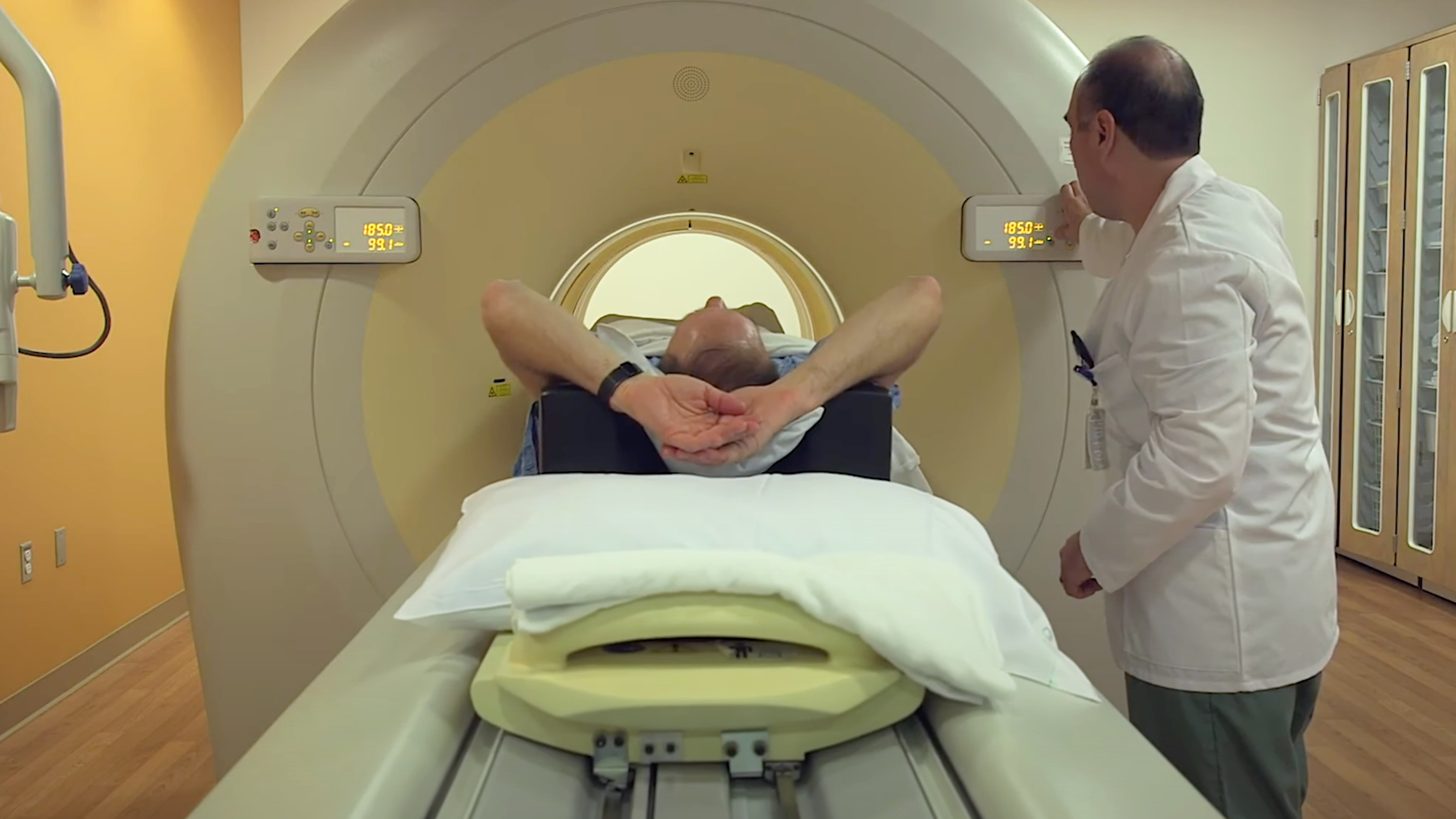
The imaging portion is quick; allow additional time for check-in and preparation.[5][7]
The scan is the beginning of a plan
What happens after the result?
- No concerning finding
- Most people who remain eligible return for another screening scan in a year. A reassuring result does not mean future screening is unnecessary.[2]
- A nodule needs a closer look
- Many lung nodules are not cancer. Reviewing older images or repeating CT sooner may clarify whether a spot is changing.[5]
- A more suspicious finding
- A multidisciplinary team may recommend additional imaging, a biopsy, or surgical evaluation. The decision depends on the finding and your overall health; every nodule does not need an invasive procedure.[9]
If surgery is recommended, Dr. Servais uses robotic minimally invasive techniques in nearly all his lung operations, including complex cases. The choice and extent of surgery are individualized.
Putting the benefits and risks in perspective
Benefits and limitations
For appropriately selected people who meet screening criteria and are healthy enough to benefit from treatment, the expected benefits of annual low-dose CT screening substantially outweigh the risks. Screening can find lung cancer earlier and reduce the chance of dying from it. Experienced interpretation and a clear follow-up plan help preserve that benefit while minimizing unnecessary testing.[3][15]
Low radiation exposure
Screening CT uses a low dose of radiation. Even with repeated annual scans, the estimated additional lifetime risk of cancer from radiation is very small. For eligible patients, this risk is much smaller than the expected benefit of detecting lung cancer early.[13]
Low false-positive rates with modern screening
Modern protocols help keep false positives low. These are findings that require evaluation but prove noncancerous. Lahey reported rates of about 10% on initial scans and 5% on repeat annual scans, compared with 8%–10% for mammography.
Most follow-up involves reviewing prior images or repeating CT, rather than biopsy or surgery.[3]
Experience and multidisciplinary care at Lahey Clinic
Lahey Clinic’s lung cancer screening program has extensive experience and an established multidisciplinary team. Radiologists, pulmonary specialists, thoracic surgeons, and other clinicians work together to interpret findings, select the appropriate next step, and coordinate follow-up. The goal is to maximize the benefit of early detection while minimizing unnecessary procedures and their risks.[6][10]
In a published study of Lahey’s screening program, fewer than 1% of screened patients underwent an invasive diagnostic or treatment procedure for a finding that proved benign.[10]
Screening still has limitations: follow-up can cause worry, additional procedures have risks, and some detected cancers might never have caused harm. A normal scan also cannot rule out every cancer or replace evaluation of new symptoms. These limitations are part of an individualized discussion—not a reason to overlook the substantial benefit for eligible patients.[1][15]
Taking the next step
How to arrange screening
Start with your primary care clinician or a lung cancer screening program. Bring an estimate of your smoking history and, if applicable, the year you quit. Ask whether screening fits your health, how to obtain an order, and what your insurance covers.
Lahey Clinic has an established low-dose CT lung cancer screening program. Its program page provides contact information and details on getting started.[6]
Lahey Clinic lung cancer screening programMedicare covers annual screening for people who meet its criteria. Other plans may use different rules, and diagnostic tests after an abnormal result may have separate costs.[4]
Clinical practice, research & national service
Dr. Servais’s work in lung cancer screening
Dr. Servais’s academic work includes the evaluation of screen-detected nodules, surgical quality, and access to screening.

National screening leadership
He chairs the Society of Thoracic Surgeons Lung Cancer Screening Task Force and is the lead author of the STS expert consensus on interventions for screen-detected lung nodules. This work addresses the decisions and quality standards that follow an abnormal screening scan.[8][9]
Rescue Lung Society
He previously served as a founding board member of the Rescue Lung Society, an organization devoted to high-quality lung cancer screening and early detection. The society brings together professionals working to improve screening programs and follow-up care.[7]
Visit Rescue Lung SocietyExplore Rescue Lung Society’s screening resources. Some materials are intended for health professionals.
More about Dr. Servais’s leadership and research →Selected publications
Research and clinical guidance
These publications include Dr. Servais as an author. The summaries below explain their focus; the articles themselves are written primarily for clinicians.
Putting screening benefits and harms in perspective
Dr. Servais was the senior lead author of the joint STS, ASTRO, and ACR statement addressing overestimation of lung cancer screening harms, including false-positive findings and radiation risk.[15]
Read the society’s summaryPublication details on PubMed
Decisions after a screening scan finds a nodule
STS recommendations on diagnostic procedures, surgical quality, timely evaluation, and multidisciplinary care.[9]
Publication details on PubMedAvoiding unnecessary procedures for benign findings
A study of a large screening program examining how often surgery or invasive testing was performed for findings that ultimately proved noncancerous.[10]
Publication details on PubMedParticipation and equity in screening
A commentary on screening access and the limitations of a one-size-fits-all approach.[11]
Publication details on PubMedMaking prior scans easier to share
Why sharing imaging between healthcare systems matters for equitable access and continuity of care.[12]
Publication details on PubMedQuestions to bring to your screening discussion
- Do I meet screening guidelines, and does my insurance cover the scan?
- How do my health and smoking history affect the decision?
- Can my earlier chest scans be obtained for comparison?
- Who will explain the result and arrange any follow-up?
- When is my next scan due?
Sources & further reading
Patient resources appear first. Publication links below provide details about Dr. Servais’s research and national service.
Patient resources, references & publications
Patient resources
- National Cancer Institute: Lung Cancer Screening (PDQ®), Patient Version.
- American Cancer Society: Can Lung Cancer Be Found Early? See also the updated ACS screening recommendations.
- US Preventive Services Task Force: Lung Cancer Screening.
- Medicare: Lung cancer screenings.
- RadiologyInfo.org (ACR / RSNA): Lung Cancer Screening.
- Lahey Clinic: Lung Cancer Screening Program.
Screening programs & professional resources
- Rescue Lung Society and its screening resources.
- Society of Thoracic Surgeons: Setting the Standard—New STS Consensus Aims to Elevate Surgical Quality in Lung Cancer Screening Programs. 2026.
Selected publications
- Servais EL, et al. The Society of Thoracic Surgeons (2025) Expert Consensus Document on Interventions for Screen-Detected Lung Nodules. The Annals of Thoracic Surgery. 2026.
- Ho H, et al.; Servais EL, senior author. Surgery and invasive diagnostic procedures for benign disease are rare in a large low-dose computed tomography lung cancer screening program. The Journal of Thoracic and Cardiovascular Surgery. 2021.
- Servais EL. Commentary: Utilization and equity in lung cancer screening: Time to abandon the 1-size-fits-all approach? The Journal of Thoracic and Cardiovascular Surgery. 2024.
- Tupper HI, et al. Imaging Interoperability: #DitchtheDisk is a Health Equity Imperative for Lung Cancer Screening and Beyond. The Annals of Thoracic Surgery. 2025.
Additional evidence on screening benefits and risks
- Rampinelli C, et al. Radiation exposure and estimated cancer risk after 10 years of low-dose CT screening. BMJ. 2017;356:j347. PubMed record.
- American Cancer Society Comprehensive Cancer Control program; Andrea McKee, MD. Lung Cancer Screening Eligibility: Knowledge Update and Equity Impact. 2021 webinar summary, pages 7–8. Cited here for historical screening outcomes and the mammography comparison, not for current eligibility rules.
- Tupper HI, et al.; Servais EL, senior lead author. Misinformation and Overestimation of Computed Tomography Lung Cancer Screening Harms—Methodology Matters. Joint statement from STS, ASTRO, and ACR. The Annals of Thoracic Surgery. 2026;121:544–547. Accessible summary from STS.
Photograph: Sharp HealthCare, “Finding lung cancer when it’s most treatable.”
Updated October 4, 2026. This guide supports a discussion with your care team. Screening recommendations and coverage may change, and eligibility should be reviewed individually.